In an era of budget cuts, institutional insularity, and an often extractive technology infrastructure landscape, Knowledge Commons is charting a different path. Through thoughtful coalition-building, values-driven decision-making, and a deeply humanistic approach to technology governance, the team is creating a sustainable, community-governed platform that advances the missions of institutions and scholars.
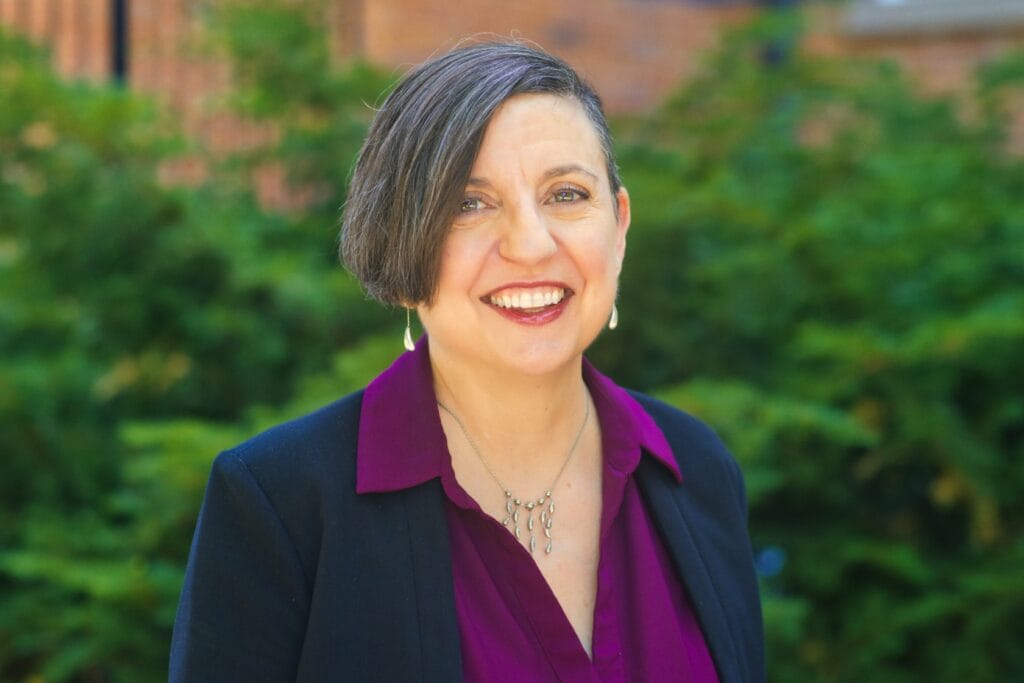
We sat down with Kathleen Fitzpatrick to discuss how Knowledge Commons has evolved since its move from the Modern Language Association to Michigan State University, how the platform is becoming mission-critical infrastructure for its host institution, and why getting institutions to think beyond "vendor mode" remains one of the field's most pressing challenges.
From scholarly society to university: A strategic hosting transition
Knowledge Commons began its life at the Modern Language Association (MLA) as an attempt to create a cooperative platform infrastructure for scholarly societies. The original vision was that societies would pool resources to support shared infrastructure, each hosting its own commons while collectively maintaining the underlying platform.
"Very quickly, we realized that no other society in the humanities other than the MLA could afford to do that," Fitzpatrick explains. However, several universities had expressed interest in how Knowledge Commons – then known as Humanities Commons – could address an infrastructure need for their faculty and students. The pivot to universities made strategic sense. Universities have more robust budgets than societies and, crucially, "have as part of their mission supporting the research infrastructure for their faculty," Fitzpatrick notes. The move to Michigan State in 2020 allowed Knowledge Commons to demonstrate what the platform could do for an institution.

Moving from a scholarly society to a university brought complex governance considerations. At the MLA, the platform operated through the organization's Executive Council. Like most public universities, MSU has a Board of Trustees that formally governs all MSU activities. This meant Fitzpatrick couldn't establish an independent “board” for Knowledge Commons without being in conflict with MSU’s policies.
The solution was to create a "governing council" instead, using language that works within institutional constraints while preserving as much as possible the spirit and practice of the platform's community-governed nature. Fitzpatrick shares that the by-laws for Knowledge Commons acknowledge that "ultimately, everything has to be approved by the Board of Trustees," though in practice, that Board allows Knowledge Commons to run autonomously unless it needs particular institutional assistance. Fitzpatrick emphasizes that, "the Governing Council is the one really making the decisions for the platform."
The Office of General Counsel at MSU has become an important partner in this work, not only by providing legal and contract support, but also as collaborators. "The folks in our Office of General Counsel have become, over time, more and more invested in our way of thinking about what this project is and how it should function," Fitzpatrick says. It's a relationship built through patient engagement and demonstrated value.
Becoming mission-critical through service
Having its new home at MSU also presented a key opportunity. The university had implemented a few separate faculty profile and document listing systems, but it had never had a campus-wide, unified institutional repository. Fitzpatrick saw the opportunity for Knowledge Commons, and worked with her team to step in to meet genuine institutional needs.
The value proposition for Knowledge Commons has only grown stronger over time. When the university library faced difficult choices due to budget cuts, the Knowledge Commons team provided services previously handled by external vendors, including data repository services. The platform now hosts MSU's institutional repository, collaborates with the campus's high-performance computing center to provide a discovery layer on the center’s massive-scale data storage, and has taken over hosting for the Center for Teaching and Learning Innovation's collaboration space. "We're becoming very clearly important to the campus," Fitzpatrick observes.
Yet this success creates its own challenges. "Because we are homegrown, the kinds of support that we're receiving from MSU are often in-kind, and sometimes a little bit tenuous," she notes frankly. The employees who work on Knowledge Commons are paid entirely through the grants and membership income generated by the Commons, and in the changing fiscal environment, that monetary support needs to be balanced with the labor and facilities provided by the university host. To do this work, the Knowledge Commons team uses their unique insight into the value and need for this platform.
The insider's advantage: Seeing institutional needs others miss
Drawing on her experience as a faculty member, Fitzpatrick knew that many of her colleagues often produce work that doesn't fit conventional publication models: white papers, reports, creative outputs, and clinical faculty scholarship. For those researchers, "their career advancement really depends on the public aspect, but not on the conventional markers of prestige that go along with journals and books," Fitzpatrick explains. One way to make that material available is through a repository like KC Works, one of the offerings from Knowledge Commons. "We realized that we had a real opportunity to reach out to those folks and show them that KC Works is a place where they can share that material." This knowledge built the foundation of KC Works and Knowledge Commons and helped to foster its success and uptake.
Now Fitzpatrick's new position as Associate Dean for Research and Graduate Studies gives her unique insight into institutional needs that traditional infrastructure often overlooks. "Being in this position has enabled me to see the wide range of work that is going on at my institution.” One example is how recent events have sharpened the message behind Knowledge Commons and KC Works as a scholar-driven platform. "The end of Twitter made it clear to a lot of people that they needed better options with better control over their work and their communication, and we can provide those better options," Fitzpatrick notes. "A scholar, researcher, instructor, or artist, they all need a place to share their work. We can provide that. It is free of charge for them. And we are a much better actor in that space than the other places where they can do this."
The KC Works platform also serves researchers without stable institutional affiliations such as contingent faculty, graduate students, and researchers beyond the academy. These audiences need infrastructure they can take with them from one position to another. For these individuals, the contrast with other ‘free to the user’ platforms — where, as Fitzpatrick notes, "everything you upload is being sold to AI mining and other nefarious purposes" — is stark, and responds to a need in the academic community for platforms that aren’t built on extraction.
Attending to the institutional realities of who needs infrastructure and why provides a strong foundation for understanding the value proposition for individuals. However, additional challenges arise when working with university administration.
Breaking out of "vendor mode": The challenge of values-based procurement
Perhaps the most persistent challenge Knowledge Commons faces is institutional procurement culture. When universities consider joining the network, "they immediately flip into vendor mode," Fitzpatrick says, asking about uptime, response times, and long-term sustainability. Even in conversations with research libraries that have championed open access, "we still find ourselves sort of put back into the vendor box."
They ask: will you be here in 10 years?
"The answer to that question is: not if you don't join," Fitzpatrick responds, acknowledging that is "not an answer that they want to hear."
Fitzpatrick and her team once again draw on their knowledge of the institution’s behaviors; in this case, they see a key advocacy opportunity for institutions involving control of their outputs. "The long-term goals that Knowledge Commons has align with the goals of the Academy to remain in control of the knowledge that it's producing," Fitzpatrick says, noting that this goal drives everything Knowledge Commons does.
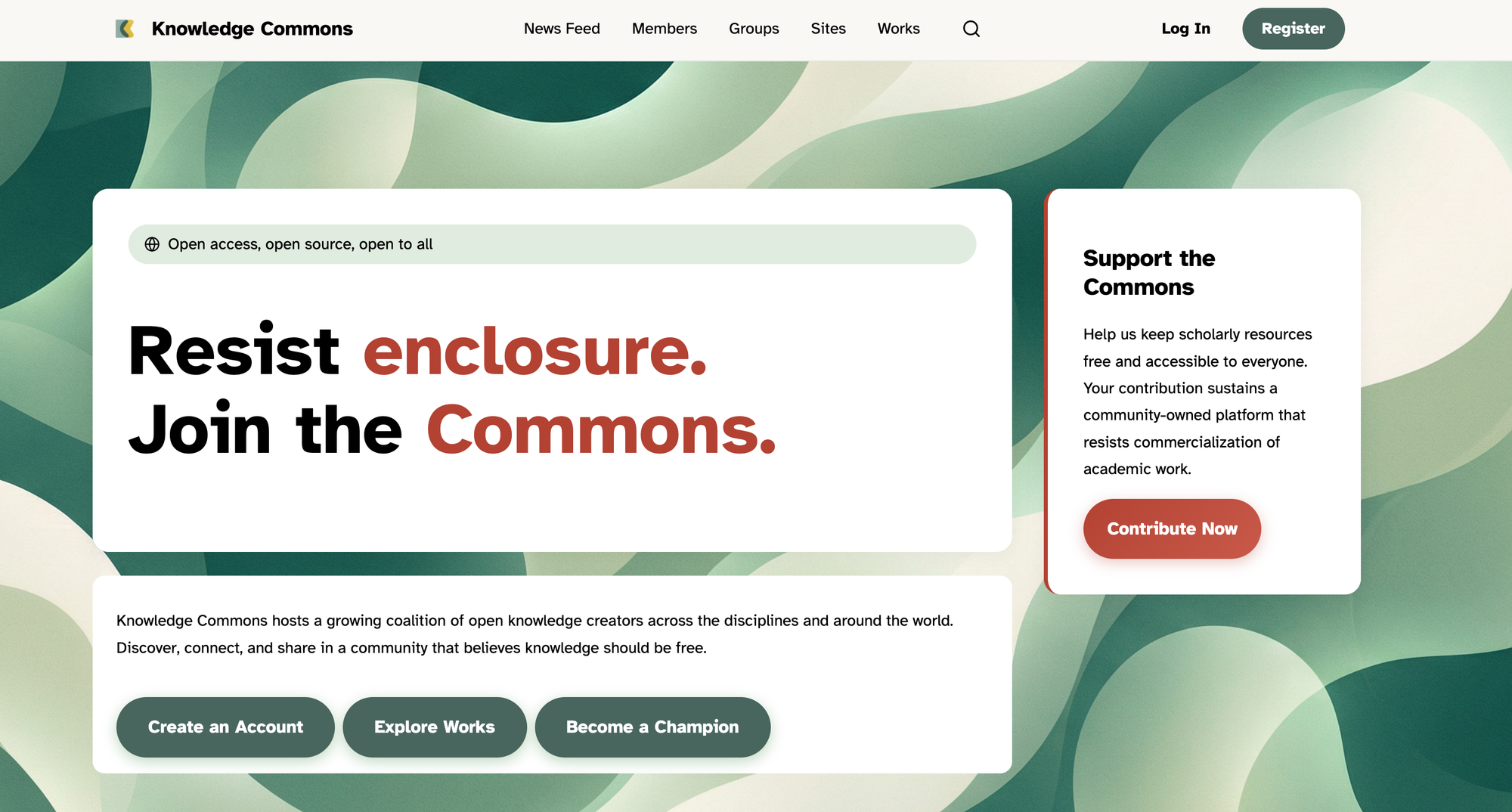
Fitzpatrick notes that institutions need to reframe Knowledge Commons not as a vendor but as a coalition. Institutions aren't purchasing a service, but rather "investing in something that they have governance rights in. It is meant to be a fully shared infrastructure that they belong to, but that also belongs to them." This perspective is rooted in Fitzpatrick’s own humanistic discipline as well as Knowledge Commons’s founding in the humanities disciplines and original creation for the Modern Language Association and its members. Community and collaboration are foundational to the platform and embedded in its operations.
The funding reality and new sustainability models
One persistent misconception is that because Knowledge Commons is free for end users, it doesn't require significant resources. "Something that's free to the end user isn't free to produce," Fitzpatrick says plainly. "There's still labor, there's still costs that have to be met. We run on a pretty tight budget. We're very lean."
She identifies two problematic institutional attitudes. First: "There is sometimes in the open access community, sometimes at large institutions like my own, a conviction that if you're selling something, you must have gone down the for-profit path, and therefore are not a good operator in open access space. Which is not true, we're just trying to remain sustainable."
Second: "There is a bias in a lot of large institutions toward major corporate providers because of the sense that though we all hate the big corporate entities, at least we know they'll still be here in 10 years." This fundamentally misunderstands what sustainable, community-governed infrastructure can be.
"It's sometimes not clear that neither of those positions are true," Fitzpatrick says. "Big corporate entities often cut product lines that aren’t producing sufficient profit or otherwise sustaining their interest, while nonprofits may be fiscally precarious and yet committed to their communities There is a space for a sustainable, non-extractive, values-based, community-governed platform."
To address funding challenges, Knowledge Commons is launching a multi-tiered approach. Beyond full institutional memberships, the new KC Champions option allows individuals to support the platform and be part of the network and provide support for the platform while receiving benefits such as custom domain mapping.
Building new tools for impact
Knowledge Commons isn't standing still. With NSF FAIROS funding, the platform is building a "publish, review, curate, assess" workflow. "The repository is the form of publication," Fitzpatrick explains. "Publication happens first, when you make a deposit. Authors can then request peer review through Pilcrow, Knowledge Commons' collaborative review platform, or submission to open access journals.”
The "assess" component addresses a critical need. A new statistics dashboard provides rich analytics on repository usage, viewable different levels from large collections down to individual deposits. "We need authors who use this process to be able to tell the story of the impact of the work at the point of annual review or promotion and tenure review," Fitzpatrick explains. “But we also know that this data is key for institutions to understand the impact of all of the knowledge they are supporting.”
The ultimate goal? "Freeing the academy from the conventional journal publishing model, which has failed us miserably."
The path forward
When asked what she wishes people understood about Knowledge Commons, Fitzpatrick's answer crystallizes the platform's challenge and promise: "I want decision makers at academic institutions and in scholarly societies – those who are dissatisfied with the tools that they've been using and with the platforms that they're paying for – to know that there are better options, and that we're one of them."
The core of that difference is that Knowledge Commons is committed to remaining free and open, to never selling user data, to never pursuing for-profit operation. But sustainability requires support from the community it serves. "We are committed to remaining not-for-profit," Fitzpatrick says. "But in order to do that, we really, really need help." That help comes from the community of institutions and individuals who invest in the Commons and participate in governance to chart the future of their shared endeavor. "As an institution joins the network, they get a seat at the table," Fitzpatrick emphasizes. "Their ability to help shape the future of the platform is its sustainability model, its governance model. That is how we transform from a platform that’s free to use right now into a genuine commons."
The path forward relies on the scholarly community recognizing this opportunity and stepping up to support it. Knowledge Commons provides a case study of how a platform serves the research community by balancing institutional realities with community governance, building sustainable funding while remaining non-extractive, and demonstrating professional capacity while maintaining values-driven operations. This kind of community-driven infrastructure is essential for the future of research.
To learn more about Knowledge Commons or explore options for institutional or individual support, visit hcommons.org or contact the team directly.