In 1537, French poet Clément Marot wrote a get-well poem to a young girl stuck in her sickbed. It runs 28 lines, each only three syllables long, rhymed in couplets. Four and a half centuries later, Douglas Hofstadter spent years translating it into English, again and again, and asked friends, students, and strangers to try their hand too. The resulting volume, Le Ton beau de Marot, is a collection of dozens of these versions.
Hofstadter showed how the confines of the three-syllable-line unleashed surprising new levels of creativity in his translations. When you can't carry every word across, you have to ask what the poem is actually doing. Then you have to find a new way to make it do that for a new reader in a new context.
I've thought a lot about this paradox since the US government abruptly withdrew federal funding for research in 2025, jeopardizing the many crucial research efforts and public information sources that depend upon it.
On the International Day of Climate Action (Oct 24), I found myself wondering if the limits now squeezing climate and environmental data in particular could be a design brief. How might constraint and creativity be used to reframe our data reclamation efforts, not as crisis response but as a fundamental reconsideration of what data is and how we need to translate it for broader audiences?
Hold context
Shortly following the 2024 US presidential election, fears that new leadership could target the world’s US-based and government funded climate and environmental data galvanized both local and international attention. Networks of librarians, archivists, researchers, community scientists, and technologists quickly activated to offset the threat of an immediate and catastrophic loss of information. They worked to identify, download, and store endangered data in fast-paced, decentralized, and volunteer-fueled initiatives.
These data rescue efforts have helped to prevent the dramatic upending of environmental vital information, as exemplified by EJ Tools and EDGI among many others. But over the last two years, data loss has progressed in complicated ways. Some data resources have vanished; others have stayed up, and still others have been altered in undocumented ways. Additional data resources are effectively lost in advance due to cuts affecting both ongoing and future data capture programs. Those that remain may be “decaying” from lack of steady maintenance in the wake of shuttered agencies and lost staffing.
The ripples continue to spread, quietly and steadily throughout the ecosystem.
Today, we’re also beginning to see the extended effects of defunding, including its impact on the open data resources whose business models depend – in part or entirely – upon grants. The landscape shift is intense and few open infrastructures will be untouched by the long-term effects of the changes to funding support.
Time is short
Constraints are real and growing. Data resources that look “healthy” on the surface (still up, still supported for now) just lost their funding models along with their funding support. IOI recently mapped out the last 25 years of grant funding received by 41 open science data resources from 38 private and federal funders. We found that 94% of these open data resources name “contributions” (grants and donations) as their top source. We also found that new US federal awards to this group fell from 81 in 2024 to just 43 awards made in 2025. Philanthropy has pulled back from open science in this same timeframe. This is especially concerning because 39% of these 41 resources report that they rely on grants alone; they have no other revenue source. These data resources are in a quiet state of jeopardy.
This quieter degradation of business models is beginning to yield a much larger and more pervasive loss of the data resources we’ve built over decades. Without broad attention, steady coordination, and careful selection, a very large number of prominent data resources that are viable today are structured for imminent business failure.
Meanwhile, climate disasters keep operating on their own schedule – accelerating whether we have the data to understand them or not. Some environmental data change slowly, so that a good “copy” of a dataset may stay useful for years (e.g., about fire history, building footprints and burn perimeters). Other datasets change by the minute (e.g., wind, rain and live fire detections) and rely on systematic, careful, and well-documented data collection. Both are crucial.
As noted by a participant in a meeting I recently attended, when a weather balloon stops going up due to funding cuts, a family's ten minutes of tornado warning may quietly shrink to two, and no one tells them that the window for evacuation has gotten smaller. The data is gone because the structure for capturing it has been eliminated.
Rescue might be able to protect the past. Only sustained infrastructure protects the present.
Copy right
The first wave of data rescue was, necessarily, primarily focused on copying: get the bytes somewhere safe, fast. That work mattered and still does – especially for those data sets that have a long life of utility. But when we asked the people doing it whether rescued data is being used, the honest answer has often been "not much."
A copy that nobody can find, trust, or combine with anything else is like a word-for-word translation of a poem. It is technically faithful but functionally unintelligible.
Many of our rescued data resources currently are not visible, validated, or connected.
That raises big questions about data users: who are they, and what do they need?
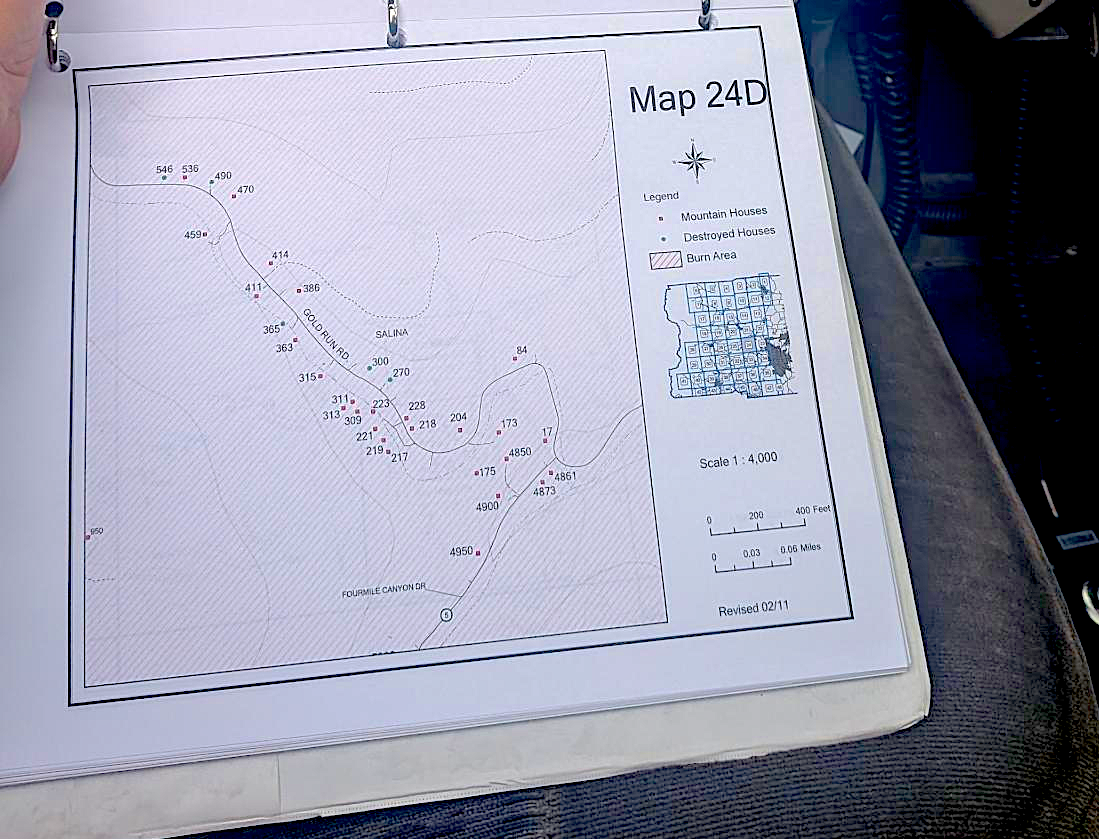
This summer, IOI interviewed wildfire prevention and response teams, a group we thought likely to be using many forms of environmental and climate data, including recently rescued datasets. A volunteer firefighter and emergency manager in Colorado sent us a photo of his department's map binder, which is the only “data” he and his team will rely upon in a true emergency due to cell phone reception limitations and power and internet outages. That map was dated 2011. Additional fire chiefs and personnel we spoke to over the last few months told us federal data often isn't fine-grained enough for the 30-100 feet around a structure that determines whether it burns; they need a closer view of the landscape to inform action, which they get by going on foot.
Hofstadter's best translators for the poems with the three-syllable lines were faithful to what the poem did, and inventive about everything else. The climate data equivalent is a sharper question than "Is it saved?" We have to also ask “What did this dataset do?” Did it warn a town about smoke, tell a farmer when to plant, or show an insurer where risk is rising? And is it in the hands of the people who need it to do those things right now?
The forest and fire crew members we spoke with had answers that surprised us. What would help in some cases wasn't a better app. It was a better map: printed, current, and built from open data that change slowly enough to stay true on paper. In a truck in the woods, with no signal and no charger, a laminated paper map is an appropriate tool. That is translation in Hofstadter's sense: carrying what the data do into a form that works for this reader, under these limits.
The point here is not that the rescued data are not useful. The point is that those who could be using the data may need it in a different format. This is not a new problem, nor one that only affects rescued data. It is a structural problem bound up in the poor scaffolding of our existing data infrastructure. If it is not addressed, rescued data may have limited use, even if they have high value.
Draw the lines
IOI’s recently issued wildfire proof of concept (September 2026) was built in short lines on purpose. We set three rules: no new central repository, compute power limited to the user's own machine, and keep answering even when a source goes dark. Each rule forced a design choice, and those choices ended up being the point.
The tool queries sources like Source Cooperative, Dryad, NOAA, NASA FIRMS, and OpenStreetMap as if they were one system. When a source disappears, it looks for a known mirror in the Data Rescue Project's catalog. If none exists, it triggers an Internet Archive capture. What we built is not another container. It is an example of the connective tissue we need between the containers we already have.
One honest lesson we’ve learned yet again as we built this proof of concept is that a tool that finds rescued copies only helps people who already know and use the content and suspect something is missing. A fire chief is unlikely to install a browser extension or visit an archive of rescued data. The people who can use this layer are the ones building tools for fire chiefs, like that map.
Others have reached similar designs from the same pressure. At the Internet Archive's Information Stewardship Forum this March, attendees talked about drought-resistant datasets: static files with good documentation and nothing that has to run around the clock. That same month, at the American Geophysical Union’s Global Data Resilience Convening in Berlin, colleagues from Indigenous data networks and low- and middle-income economies reminded the room that they have been designing under political and funding instability for decades. The constraint is new to many US institutions. It is not new.
When no one can afford to build the whole thing, the designs that work are shared ones. Constraint provokes creativity. It also rewards collaboration.
Ask and learn
I don't have answers today, but I do have a lot of questions about “data resilience” and the perpetuity infrastructure we need, but do not have, for data. I’ll share just a few:
- Can we shift some of our focus from saving data to increasing its usefulness? We can’t (and shouldn’t) “save” everything; what happens if our focus shifts from the data to its use? What does each climate dataset do, and for whom? Can that better inform selection and action?
- Who are the users and readers? Most “data rescue” and even “data resilience” efforts focus first on academic researchers, repository managers, and tool creators. Who else needs the data, and what do their needs entail? Emergency managers, state agencies, and community science networks are already building workarounds for data that is no longer collected or has been “disappeared”. Are they in the room when we decide what to rescue or how to rescue it?
- What would drought-resistant funding models include? Our longstanding models supporting the creation, management, and ongoing monitoring of data have relied heavily on federal subsidies that have been quickly withdrawn. This moment has revealed that many of our most important data resources are one short grant cycle away from serious disruption or full-on failure. How can we quickly activate to construct business norms and funding structures that help to offset preventable failures in this critical moment? How can we make sure that this moment does not undercut the openness of so many of our core data infrastructures, including their hardware, software, and organizational structures?
Get well soon
Marot wrote his poem to wish someone back to health, not to preserve her in the state that she was in. Climate data isn't gone, but its health is deeply compromised, and that situation actually predates this moment–as I’ve said elsewhere, the crisis really hasn’t broken things so much as it has revealed what was already broken. Our goal can’t be to restore exactly what existed in some previous moment in time. It is to find the form that lets this data keep doing its work for whoever needs it next, whether that's a researcher, a farmer or a fire chief holding a fifteen-year-old binder.
Want to build, test or fund this work with us? Write to contribute@investinopen.org.
–
Giving credit where credit is due: Lauren Collister wrote the poem (did you find it?) and edited this piece (thank you, Lauren!).