How does an organization know if it's financially healthy? When does a warning sign become a real risk — and when it does, what level of response is needed? Most nonprofits have financial reporting. What's harder is knowing what to do with what it's telling you: whether a funding gap calls for immediate action, careful monitoring, or something in between.
At Invest in Open Infrastructure (IOI), these questions kept surfacing in our steering committee conversations. Standard reporting told us where we stood; it didn't tell us when to move. So we built something that could.
The problem
Non profit and open infrastructure organizations often face a particular version of this challenge: high grant dependency, a heavy reliance on restricted funding that limits flexibility, long and uncertain pipeline cycles, small teams, and a constant tension between mission work and financial sustainability. In conversations with peers and funders across the sector, we found no consistent shared framework for measuring financial health in organizations like ours. Funders care about it deeply: they don't want to invest in organizations that won't be viable when the grant ends, but approaches vary widely. We set out to build something for ourselves, and in doing so, we think we've built something others can use too.
What we built
10 indicators, split into three categories:
- Critical runway: will we survive the next 12 months?
- Pipeline health: is our pipeline strong enough?
- Sustainability: are we building towards financial sustainability?
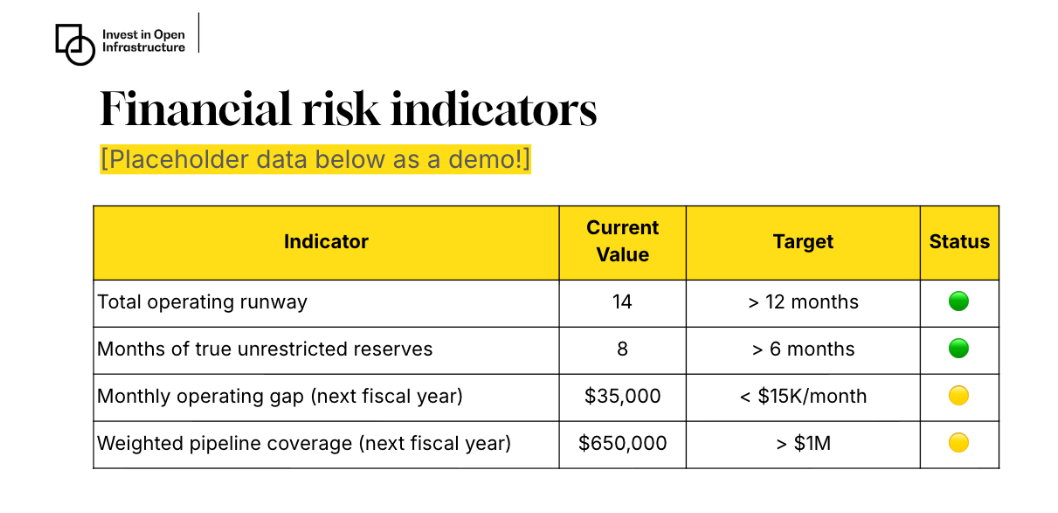
One example indicator is weighted pipeline coverage: the sum of committed revenue and projected revenue for the coming fiscal year, where each projected opportunity is multiplied by its probability of closing. The formula is simple; the calibration is not. What probability do you assign to a grant you've submitted but haven't heard back on? How realistic are your pipeline stages and their associated probability ‘scores’? Getting those judgments right, and agreed upon, takes deliberate work and iteration.
We connected the indicators to two layers of decision-support: a traffic light system that signals the health of each individual metric, and a decision trigger framework that looks across indicators together to determine what phase of risk we’re in, and what pre-defined actions that phase requires. That second layer, built and agreed with our steering committee, is what turns monitoring into decision-making.
What we’ve learnt
- You can't monitor what you can't measure. Before the indicators could run reliably, we needed data infrastructure many small organizations don't have: mature pipeline management, disciplined data hygiene, processes that connect opportunity tracking to financial reporting. This work is often the real prerequisite, and where organizations often need help first.
- Indicators without alignment are just data. Defining what “amber” or “red” means requires explicit conversations with leadership and governance about risk appetite — conversations many organizations haven't had. Co-designing the framework with your stakeholders, rather than presenting it to them, is what turns a monitoring tool into a shared decision-making language.
- This is a diagnostic tool, not a cure. Its value is moving from we're worried about our finances to our pipeline coverage is below threshold, and here's the specific action we've agreed to take. That specificity transforms financial monitoring from a source of ambient anxiety into a strategic tool: giving leadership and governance a shared language, agreed thresholds, and the confidence to know not just what is happening, but what to do about it.
IOI offers support in building financial risk monitoring frameworks tailored to your organization, from indicator design and governance alignment to data infrastructure and implementation. If you’re interested in exploring this, get in touch!